
















How to Find Your Equipment Model Number.
Finding the right parts for your equipment is easy when you have your model and serial number which can be found on the data plate. Luckily, a forklift data plate is installed on every truck on the market to help you understand what your forklift can do and provide vital information.
Model Number: The model number of your toyota forklift is extremely important for relaying information to your dealers about repair or technical assistance and for looking up replacements part!
Serial Number: The serial number on your lift is the most important number.The model serial number combination will allow us to provide you with the parts that will fit your particular piece of equipment.
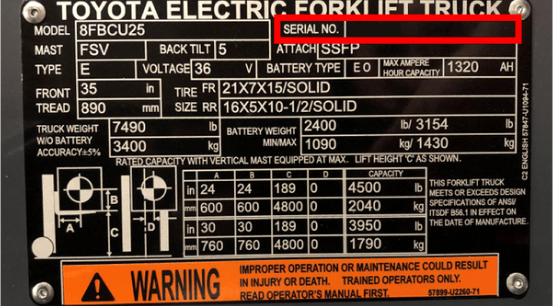
How to Find Your Equipment Serial Number.
Finding the right parts for your equipment is easy when you have your model and serial number which can be found on the data plate. Luckily, a forklift data plate is installed on every truck on the market to help you understand what your forklift can do and provide vital information.
Model Number: The model number of your toyota forklift is extremely important for relaying information to your dealers about repair or technical assistance and for looking up replacements part!
Serial Number: The serial number on your lift is the most important number.The model serial number combination will allow us to provide you with the parts that will fit your particular piece of equipment.
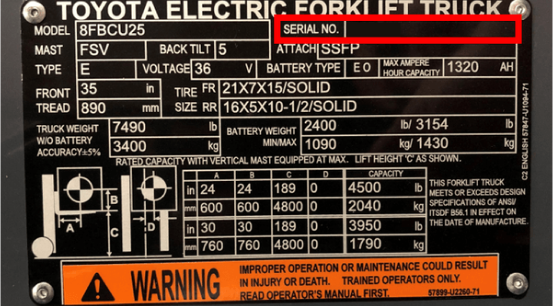
Need some help? For further assistance or more information, contact your local Toyota Dealer.












Please click below to sign in to your MyToyota account
Don't have an account?
Assessing Forklift Charging Methods

What is Forklift Charging?
Forklift charging refers to the process of recharging electric forklift batteries to keep equipment operating efficiently throughout the workday. Choosing the right electric forklift charging method can impact battery life, productivity, warehouse space utilization, and overall operational efficiency.
Depending on your operation and the number of shifts your forklifts are running, different charging methods may work better for your facility. Selecting the wrong charging strategy can reduce productivity, increase battery wear, and impact long-term ROI. Toyota Energy Consultants help operations evaluate battery usage, charging needs, and fleet utilization to determine the best energy solution for their application.
Conventional Forklift Battery Charging
Conventional forklift battery charging occurs when a battery is placed on a charger at the end of a shift and returned to service once charging is complete.
This charging method is commonly used in one-shift operations where forklifts have downtime available for overnight charging, or in very heavy use applications where the one-battery-per-truck methods of Fast or Opportunity Charging will not be able to keep up with the operational demand. In this case, one battery per shift is used. For example, a heavy-use, three-shift application will deploy three batteries per truck: one in use, one on charge, and one cooling down. Conventional charging supports battery lifespan when properly maintained, and as mentioned above, multi-shift operations may require additional batteries, battery storage space, and battery handling equipment.
Fast Charging
Fast charging partially charges batteries during breaks or between shifts throughout the day.
This method is commonly used in multi-shift operations where forklifts need to remain operational as frequently as possible. Fast charging can reduce downtime and minimize the need for spare batteries by charging at opportune times throughout the day that do not interrupt productivity. For lead-acid batteries, this charging method may also increase battery wear over time; however, newer battery chemistries such as lithium-ion are more robust against this more aggressive charging method. Fast charging typically requires dedicated charging equipment.
Operations using lead-acid batteries with fast charging also typically require periodic full charging, weekly battery equalization, and weekly cool-down for up to 24 uninterrupted hours to help maintain acceptable battery service life. It is important to recognize that even a properly maintained lead-acid battery is used more than one cycle per day and will inherently have a shorter service life than a properly cared-for conventional application battery that sees only one discharge cycle per day. Lithium batteries do not require the same type of charging and cool-down that lead-acid batteries do.
Opportunity Charging
Opportunity charging allows operators to charge electric forklifts during breaks and shift changes throughout the day at opportune times that do not interrupt productivity.
Unlike fast charging, opportunity charging uses lower charging rates and is commonly used in multi-shift warehouse operations where the average usage is approximately 1.5 times the battery’s usable daily capacity. This charging method can help reduce battery change requirements, eliminating battery rooms and changing equipment, and improve forklift uptime and productivity, but it requires compatible chargers and consistent charging schedules. Similar to Fast charging, lead-acid batteries require periodic full charging, weekly battery equalization, and weekly cool-down for up to 24 uninterrupted hours to help maintain acceptable battery service life. It is important to recognize that even a properly maintained lead-acid battery is being used more than one cycle per day and will inherently have a shorter service life than a properly cared for Conventional application battery that only sees a maximum of one discharge cycle per day. Lithium batteries do not require the same type of charging and cool-down that lead-acid batteries do.
How to Choose the Right Forklift Charging Method
The best forklift charging method depends on several operational factors, including fleet size, number of shifts, available charging space, available charging time, uptime goals, and long-term maintenance plans.
Conventional charging may work best for one-shift operations, while fast or opportunity charging is often better suited for multi-shift facilities. Bear in mind that when the operational demand of three-shift operations becomes too heavy, the one-battery-per-truck approach of Fast or Opportunity Charge cannot keep up with the power demand, and a one battery per shift per forklift (3-shift = 3-batteries/truck) approach becomes the more feasible solution.
Toyota Energy Consultants can also perform power studies to help operations understand run-time, available charge time, shift schedules, and charging requirements. These studies help businesses evaluate battery needs, charging infrastructure, and opportunities to improve efficiency throughout the facility.
Working with an authorized Toyota Forklift Dealer can help determine the right electric forklift charging strategy for your operation.
Frequently Asked Questions About Forklift Charging
How do you charge a forklift battery?
Electric forklift batteries are charged by connecting the battery to a compatible charger designed for the battery type and charging method being used.
What is the difference between fast charging and opportunity charging?
Fast charging uses higher charging rates to quickly recharge batteries, while opportunity charging uses lower charging rates during breaks and shift changes throughout the day.
What is the best forklift charging method?
The best charging method depends on your operation, shift schedules, uptime requirements, and battery management strategy.
Can incorrect forklift charging damage a battery?
Yes. Using incompatible chargers or improper electric forklift battery charging procedures may reduce battery life and impact performance.
For more information or assistance assessing forklift charging methods, contact a locally authorized Toyota dealer today!