



















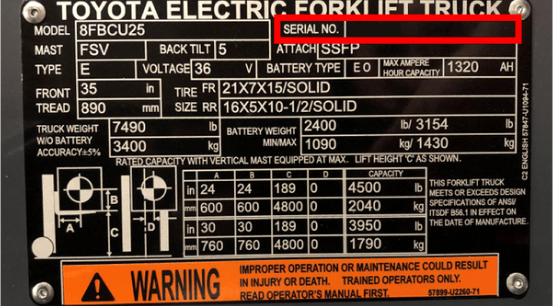
How to Find Your Equipment Model Number.
Finding the right parts for your equipment is easy when you have your model and serial number which can be found on the data plate. Luckily, a forklift data plate is installed on every truck on the market to help you understand what your forklift can do and provide vital information.
Model Number: The model number of your toyota forklift is extremely important for relaying information to your dealers about repair or technical assistance and for looking up replacements part!
Serial Number: The serial number on your lift is the most important number.The model serial number combination will allow us to provide you with the parts that will fit your particular piece of equipment.
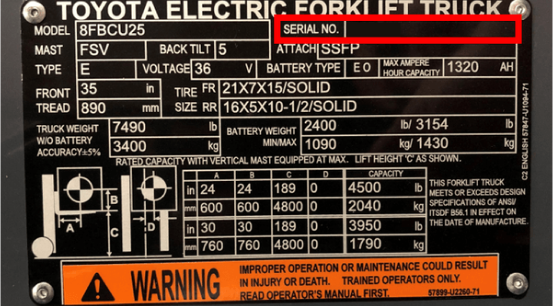
How to Find Your Equipment Serial Number.
Finding the right parts for your equipment is easy when you have your model and serial number which can be found on the data plate. Luckily, a forklift data plate is installed on every truck on the market to help you understand what your forklift can do and provide vital information.
Model Number: The model number of your toyota forklift is extremely important for relaying information to your dealers about repair or technical assistance and for looking up replacements part!
Serial Number: The serial number on your lift is the most important number.The model serial number combination will allow us to provide you with the parts that will fit your particular piece of equipment.
Need some help? For further assistance or more information, contact your local Toyota Dealer.











Please click below to sign in to your MyToyota account
Don't have an account?
Pneumatic Tire Forklifts FAQ
?bfc=on&fmt=jpg&qlt=70)
Common Pneumatic Tire Forklift Questions
What is The Difference Between Pneumatic and Cushion Tire Forklifts?
Pneumatic tire forklifts are designed for outdoor or rough-terrain use, with air-filled or solid rubber tires that provide better traction on uneven surfaces. Cushion tire forklifts, on the other hand, are best suited for smooth, indoor environments like warehouses.
Are Pneumatic Tire Forklifts Available in Electric and Internal Combustion Models?
Yes, pneumatic tire forklifts are available in both electric and internal combustion (diesel, LPG, and gas) models to suit different operational needs and fuel preferences.
What Is the Typical Lift Capacity of a Pneumatic Tire Forklift?
Lift capacities can vary widely, from 3,000 lbs. to 125,000 lbs., depending on the model and configuration. Heavy-duty models are commonly used in construction, lumber, and manufacturing industries.
When Should I Choose a Pneumatic Tire Forklift Over a Cushion Tire Forklift?
Choose pneumatic tire forklifts if your application includes outdoor yards, gravel lots, construction sites, or uneven terrain. They offer more durability and ground clearance than cushion tire models.
What Kind of Maintenance Does a Pneumatic Tire Forklift Require?
Like all forklifts, regular maintenance is key. Pneumatic models may require more frequent tire inspections, especially if operating on abrasive or debris-covered terrain. Toyota’s planned maintenance programs can help reduce downtime.
Can I Replace Pneumatic Tires with Solid Pneumatic Tires for Added Durability?
Yes. Solid pneumatic tires are a great option for users needing flat-resistant performance in harsh outdoor conditions. However, this change may slightly affect ride comfort and should be discussed with your dealer or service technician.
How Do Pneumatic Tire Forklifts Perform on Uneven or Outdoor Terrain?
Pneumatic tires offer better shock absorption and traction than cushion tires, making them ideal for outdoor environments with gravel, dirt, or uneven surfaces. Their larger diameter and tread design help maintain stability and control.
What's the Difference Between Air-Filled Pneumatic and Solid Pneumatic Tires?
Air-filled pneumatic tires provide a smoother ride and better traction, but are more susceptible to punctures. Solid pneumatic tires are made of dense rubber and offer greater durability and puncture resistance, making them ideal for rough or debris-covered surfaces.
Can Pneumatic Tire Forklifts Be Used Indoors?
Yes, but only in facilities that can accommodate their larger turning radius and higher ground clearance. They’re typically used in operations where forklifts must move seamlessly between indoor and outdoor environments.