














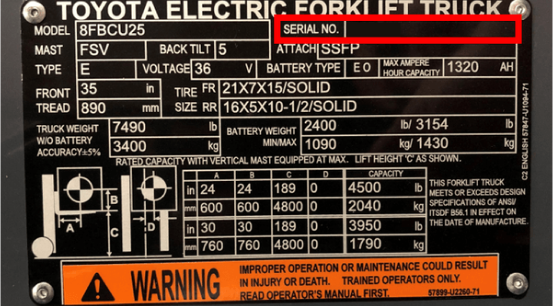
How to Find Your Equipment Model Number.
Finding the right parts for your equipment is easy when you have your model and serial number which can be found on the data plate. Luckily, a forklift data plate is installed on every truck on the market to help you understand what your forklift can do and provide vital information.
Model Number: The model number of your toyota forklift is extremely important for relaying information to your dealers about repair or technical assistance and for looking up replacements part!
Serial Number: The serial number on your lift is the most important number.The model serial number combination will allow us to provide you with the parts that will fit your particular piece of equipment.
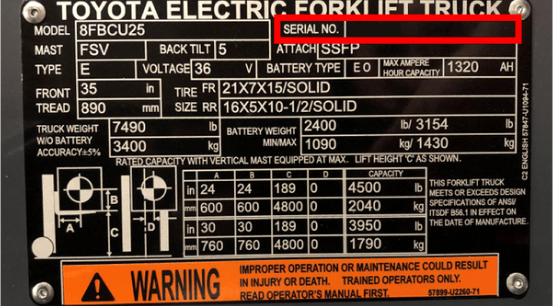
How to Find Your Equipment Serial Number.
Finding the right parts for your equipment is easy when you have your model and serial number which can be found on the data plate. Luckily, a forklift data plate is installed on every truck on the market to help you understand what your forklift can do and provide vital information.
Model Number: The model number of your toyota forklift is extremely important for relaying information to your dealers about repair or technical assistance and for looking up replacements part!
Serial Number: The serial number on your lift is the most important number.The model serial number combination will allow us to provide you with the parts that will fit your particular piece of equipment.
Need some help? For further assistance or more information, contact your local Toyota Dealer.











Please click below to sign in to your MyToyota account
Don't have an account?
Forklift Size Decisions: What Forklift Capacity Do I Need?

Forklift capacity refers to the maximum weight a machine can safely lift at a specific load center. Determining the right forklift size and weight capacity requires analyzing your heaviest typical load, your maximum lift height, and your standard aisle dimensions. Standard forklift lifting capacity ranges from 3,000 to 17,500 pounds.
Every forklift has strict limitations on the amount of weight it can lift and how high it can carry that load. When choosing a new machine, calculating your required forklift capacity is the most critical step to ensure operational safety and efficiency. Every forklift and its attachments have an OSHA-required data plate that specifies its maximum load capacity.
Key Requirements for Sizing Your Forklift
Before you begin researching specific models, you need to audit your facility and typical loads. Use this checklist to map out your operational requirements:
Operational Factor | Key Measurement | Impact on Equipment |
Load Weight | Weight of your heaviest typical pallet/load. | Dictates the minimum base forklift weight capacity required. |
Aisle Space | The width between your tightest racking. | Determines the physical forklift dimensions and turning radius needed. |
Vertical Storage | Maximum height of your highest rack shelf. | Defines your required forklift height and mast specifications. |
| Environment | Indoor (smooth floors) vs. Outdoor (gravel/dirt). | Determines tire type (cushion vs. pneumatic) and fuel type (electric, fuel cell, LP, Gas, diesel) |
Understanding Forklift Weight Capacity and Load Centers
While the base capacity tells you how much the machine can lift, that number is directly tied to the load center. A load center is the horizontal distance from the front, vertical face of the forks to the center of gravity of the load.
The load center serves as the standard base for rating the forklift's load capacity. The Industrial Truck Standards Development Foundation (ITSDF) places the load center at 24 inches on most standard forklifts. If your load is longer or irregularly shaped, the center of gravity shifts, which may reduce the forklift lifting capacity.
Matching Forklift Dimensions to Your Aisle Width
Another vital factor to keep in mind is the machine's physical footprint. You must ensure your forklift dimensions leave plenty of space to maneuver in tight aisles and narrow racking.
Forklift sizes vary greatly depending on the model and tire type. The dimensions of most four-wheel IC (Internal Combustion) and cushion tire forklifts range from about 3 feet wide for smaller models to 8 feet wide for high-capacity, heavy-duty outdoor machines. Always measure your tightest operational bottleneck to ensure safe passage.
Evaluating Maximum Forklift Height
If you utilize a high-density racking system, forklift height is a major factor. If your loads are lifted to a variety of heights, you must use your absolute maximum vertical height when determining what forklift you need. Lifting a heavy load to maximum height changes the center of gravity of the forklift and load combined and impacts stability, which is why matching the mast height to your capacity needs is essential.
Frequently Asked Questions About Forklift Sizes
How is forklift lifting capacity determined?
Capacity is determined by the manufacturer based on the machine's counterweight, mast type, and a standardized 24-inch load center. If your load is unusually long or wide, your safe lifting capacity may vary.
What are the standard forklift sizes?
Standard warehouse forklift sizes typically range between 3 and 4 feet in width and require 10.5 to 12 feet of aisle space to turn comfortably. However, heavy-duty outdoor models can be significantly wider and longer.
How do I know what size forklift I need?
To find the right size, measure your heaviest load, your highest rack, and your narrowest aisle. Knowing these three metrics will allow a professional to match you with a machine that has the correct weight capacity, mast height, and physical footprint.
Knowing your operational needs is vital. To determine exactly which capacity and size best fit your application, request a quote or contact your local Toyota Dealer for an expert consultation.