
















How to Find Your Equipment Model Number.
Finding the right parts for your equipment is easy when you have your model and serial number which can be found on the data plate. Luckily, a forklift data plate is installed on every truck on the market to help you understand what your forklift can do and provide vital information.
Model Number: The model number of your toyota forklift is extremely important for relaying information to your dealers about repair or technical assistance and for looking up replacements part!
Serial Number: The serial number on your lift is the most important number.The model serial number combination will allow us to provide you with the parts that will fit your particular piece of equipment.
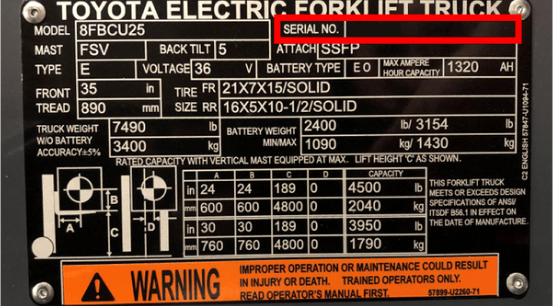
How to Find Your Equipment Serial Number.
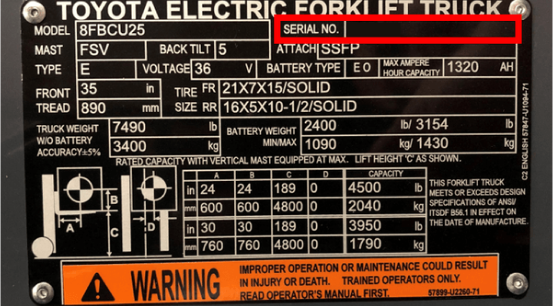
Finding the right parts for your equipment is easy when you have your model and serial number which can be found on the data plate. Luckily, a forklift data plate is installed on every truck on the market to help you understand what your forklift can do and provide vital information.
Model Number: The model number of your toyota forklift is extremely important for relaying information to your dealers about repair or technical assistance and for looking up replacements part!
Serial Number: The serial number on your lift is the most important number.The model serial number combination will allow us to provide you with the parts that will fit your particular piece of equipment.
Need some help? For further assistance or more information, contact your local Toyota Dealer.











Please click below to sign in to your MyToyota account
Don't have an account?
What Are Pneumatic Tires, And Why Are They Used For Many Outdoor Applications?

Quick Summary: Pneumatic tires are rubber tires filled with compressed air, providing shock absorption, and are suitable for both indoor and outdoor applications, offering improved traction on uneven or rough surfaces. Cushion tires are constructed from a solid rubber material encasing a metal band, ideal for indoor environments and warehouses.
Pneumatic tires are heavy-duty, rubber tires filled with compressed air or solid rubber, designed specifically for outdoor and rough-terrain material handling. Similar to standard car or truck tires, they feature thick treads that provide superior shock absorption and traction on uneven surfaces.
Every operation needs the right tool for the job. Choosing the correct tire type for a forklift is extremely important for both safety and efficiency. When it comes to working on uneven terrain or transitioning between different outdoor surfaces, a pneumatic tire forklift is your best bet for standing up to the challenge.
But what exactly is a pneumatic tire, and why are they the best choice for outdoor use? Here is a breakdown of pneumatic tires, how they differ from cushion tires, and the benefits of having them on your outdoor fleet.
Types of Pneumatic Tires: Solid vs. Air
When researching pneumatic tires' meaning, it's important to know there are two distinct variations:
- Air Pneumatic Tires: These are filled with compressed air, providing a cushioned ride that is ideal for rough, uneven terrain like gravel or packed dirt.
- Solid Pneumatic Tires: Made entirely of solid rubber, these tires are completely puncture-resistant. They are best suited for rugged environments littered with sharp objects such as nails, glass, rocks, or metal debris (such as lumber yards or recycling centers)
What Are the Benefits of Pneumatic Tires?
Pneumatic tires are known for their versatility and durability. Key benefits include:
- Shock Absorption: Whether solid or air-filled, they excel at absorbing the impact of uneven terrain, providing a smoother ride with reduced bumping and shaking, which enhances operator comfort and reduces fatigue.
- Thick Treads: Their thicker rubber treads offer superior traction, making it easier to navigate loose, wet, or uneven surfaces with stability and control.
- Increased Uptime: Designed specifically for rugged outdoor applications, they withstand challenging conditions better than indoor tires, reducing wear and tear over time and minimizing maintenance downtime.
Pneumatic Tires vs. Cushion Tires
There is a large difference between pneumatic and cushion tires, and your choice will dictate where your forklift can operate.
Feature | Pneumatic Tires | Cushion Tires |
Primary Environment | Outdoors / Rough Terrain | Indoor/ Smooth Warehouse Floors |
Material | Air-filled rubber or solid rubber | Solid Rubber encasing a metal band |
Traction | High (Thick treads for loose surfaces) | Low (Designed for smooth concrete) |
Best Application | Lumber yards, construction, outdoor lots | Warehouses, distribution centers, manufacturing |
While pneumatic tires offer versatility and can be used both indoors and outdoors, their larger size and increased ground clearance typically result in a wider turning radius compared to cushion tire models. On the other hand, cushion tires excel at indoor tasks that require precise, nimble handling. Cushion tires should never be used on rough outdoor terrain.
Need Help Choosing?
Finding the right forklift for the job can be a hassle. Contact your local Toyota Forklift dealer today and let the experts guide you to the pneumatic forklift that fits your specific outdoor needs.
Frequently Asked Questions
What does pneumatic tire mean?
In material handling, the term "pneumatic" refers to a heavy-duty, treaded tire designed for outdoor use. While the word originally meant "containing air," modern pneumatic forklift tires can be either air-filled or solid rubber.
Can a pneumatic tire forklift be used indoors?
Yes, a pneumatic-tired forklift can be driven indoors on smooth concrete. However, because they have a larger footprint and a wider turning radius than cushion-tire forklifts, they require wider aisles to operate indoors.
Which is better: solid or air pneumatic tires?
It depends on the environment. Air pneumatics offer a smoother ride on bumpy terrain and are generally less expensive. Solid pneumatics cannot be popped or punctured, making them better for sites with debris, though they provide a slightly rougher ride.