




How to Find Your Equipment Model Number.
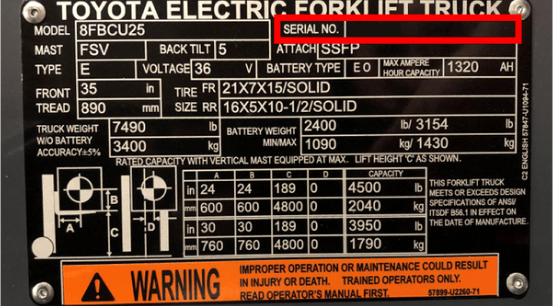
Finding the right parts for your equipment is easy when you have your model and serial number which can be found on the data plate. Luckily, a forklift data plate is installed on every truck on the market to help you understand what your forklift can do and provide vital information.
Model Number: The model number of your toyota forklift is extremely important for relaying information to your dealers about repair or technical assistance and for looking up replacements part!
Serial Number: The serial number on your lift is the most important number.The model serial number combination will allow us to provide you with the parts that will fit your particular piece of equipment.
How to Find Your Equipment Serial Number.
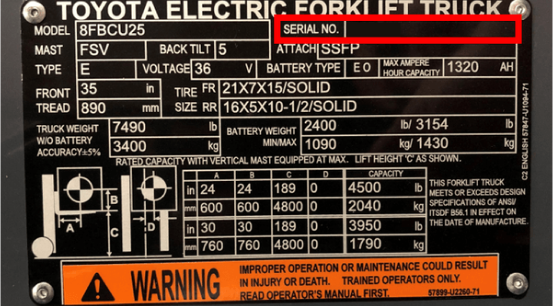
Finding the right parts for your equipment is easy when you have your model and serial number which can be found on the data plate. Luckily, a forklift data plate is installed on every truck on the market to help you understand what your forklift can do and provide vital information.
Model Number: The model number of your toyota forklift is extremely important for relaying information to your dealers about repair or technical assistance and for looking up replacements part!
Serial Number: The serial number on your lift is the most important number.The model serial number combination will allow us to provide you with the parts that will fit your particular piece of equipment.
Need some help? For further assistance or more information, contact your local Toyota Dealer.









Please click below to sign in to your MyToyota account
Don't have an account?
Intern-to-Associate Journey with Cesar Jimenez
Quick Summary: As part of our Intern-to-Associate series, Toyota Material Handling interns sit down with former interns who have built their careers at TMH. Through conversations about career growth and mentorship, TMH Associates reflect on where they started, what keeps them at Toyota, and the experiences that have shaped their careers. Whether you’re just starting out or have decades of industry experience, hear their perspectives on learning, growth, and building a meaningful career.
Please introduce yourself. What is your current role at Toyota? How long have you been with the company?
Sophia: Hi, my name is Sophia Jimenez, and my current role at Toyota is Business Analyst Intern with Advanced Services Operations team.
Cesar: I’m Cesar Jimenez, Vice President of Regulatory Affairs and Product Planning. I’ve been with Toyota, actually approaching 30 years, January of next year. Now, since we are here to talk about internships, if I include my internship, this summer is my 30th year. I actually worked for Toyota back in the summer of 1996. But this was when we were still in California. And, actually, TIE, Toyota Industrial Equipment, was a division of the car side, so Toyota Motor Sales. This was back in Torrance, California.
Sophia: He’s actually my dad.
Sophia: Tell us about your Toyota internship experience. What year did you intern, and what was your role?
Cesar: Sure, like I mentioned before, my internship was actually May of ‘96, maybe sometime late May of ’96 when I finished my junior year in college. Then it ended sometime in August when I went back to finish my senior year. So, my role, funny enough, I know some of you have met Brett Wood, so I have a long history with Brett Wood. He was actually my boss as a summer intern. So, it was funny when I told him that 30 years later, he was going to have another Jimenez as a summer intern at Toyota. At that time, Brett was the Product Planning Manager, and so I was under his leadership in the Product Planning Group. I don’t remember actually having a title other than “Summer Intern,” so things have progressed and changed quite a bit in 30 years, but I was under the Product Planning Department, working for Brett.
Sophia: Looking back on your internship, what were some of the most valuable lessons or experiences you gained?
Cesar: Looking back, actually, I would say the most valuable lesson is accountability, maybe. The reason why I say that is because I do remember Brett was pretty busy. Just like he is busy now, he was pretty busy back then. At that time, he was actually traveling most of the summer doing prototype evaluations with one of our new products that we were getting ready to introduce in 1996. And I remember very clearly him giving me a set of instructions and assignments at the beginning of my internship and telling me, “By the way, my expectations are that if you have any questions, you are going to reach out to me. And if you need anything, you can reach out to me, because I will not be here. I’m traveling for most of the summer.” So, I needed to make sure that everything he gave me as an assignment that I got done and completed to his liking and on time. So, I think that was maybe the most important thing that I learned is being accountable. I really appreciated that, because as a college kid, obviously at that time, I was expected to be micromanaged quite a bit. And so, it was surprising to me that I was not. I was trusted from the very beginning. And I appreciated that, actually, and I think it’s helped me along the way. And obviously I’m still here working at Toyota, so I think it worked out pretty good.
Sophia: What inspired you to return to Toyota after your internship experience?
Cesar: Other than the fact that having the opportunity to work for a great company like Toyota, right, I think that most people know Toyota from the car side, not from forklifts or material handling. Obviously, growing up, my parents had Toyotas, and we knew the quality of Toyotas. Just the brand name and the recognition. But you know some of the relationships that I have built at Toyota really is what brought me back.
I felt when I was working at Toyota as an intern, I was valued in my thoughts and opinions were important to others. I did appreciate the fact I was given a little bit more of an opportunity, maybe to speak up, simply because I was a summer intern. But I think the fact that I felt valued at the company is what made me feel comfortable to come back to work for Toyota. And it felt like a culture that I wanted to belong to.
And of course, like I said before, just the brand recognition. And part of it was also loyalty to the company. I think you know a little bit about that story, is the fact that you know I grew up in an underprivileged home. And I actually had a scholarship to go to school from Toyota. And with that strong financial help, I was able to go to the University of Southern California. It was a private school, which was not inexpensive to say the least. And because of the financial support that they gave me, and obviously the internship and the opportunities that they gave me, I felt a little bit of loyalty.
And so, I felt like I needed to give back, but I think it has worked out for me pretty well. So, I’m glad I was thinking that way, that this is a great company to come back and work for. Here you are as well, working at Toyota as an intern.
Sophia: During your internship, what relationships or professional connections did you build, and how have those connections supported your career?
Cesar: Sure, you know we were part of the car side, like I mentioned earlier. So, we were Toyota Industrial Equipment, which was a division of TMS at that time. So, our division was fairly small. So, what I really enjoyed about the internship was the fact that I had an opportunity to get involved in many different things.
My background, as you know, is engineering, but I’ve never done any engineering work my entire career. I grew up in the product planning side; I worked with a lot of engineers. And as part of that process, I was able to work with a lot of different people in the organization. Whether that be in pricing, marketing, obviously in product planning, training, which also gave me access to work with other leaders very early in my career. The fact that the group was small, as well.
I remember obviously working with Brett as my boss, I worked with other people like Dale M., who was in the training department, Shankar Basu, who was maybe not president of our division at that time, but was pretty high up. Who eventually became the president of our group when we separated from the car side, and now runs Toyota dealer. So, building those relationships with different people gave me the opportunity to get to a level where I could feel comfortable to reach out to them in case I needed any help, any advice, any guidance on future growth, future direction.
As an example, I still remember obviously as we were part of the car side, and it was an opportunity for me to actually move over to the car side and not the stay with the forklift division when we separated. But, obviously, one of the people I spoke to was Brett Wood about what were his thoughts and advice of what I should do moving forward in my future career. And obviously, he gave me some pretty good advice, and I’m still here. And obviously, as you know, that is part of the reason why we are not in Southern California, and we are in Columbus, Indiana. Part of that opportunity to move with the company and come here and continue to add value to the organization, and to continue to grow.
But the best relationship, obviously for me: I’ve had a long relationship with Brett now spanning 30 years, and obviously we know his wife and daughter, so that’s been very nice to know him for a long time. He’s been a good friend, as well.
Sophia: What advice would you share with current or prospective Toyota interns who are looking to make the most of their experience?
Cesar: The main advice is just to build relationships. That’s the key. You know you are going to get an opportunity to meet a lot of people. Make sure you open up, not be shy and embarrassed about your past or career goals, or the fact that you are young. Ask many questions that sometimes don’t make sense; that’s okay. You’re here to learn. Part of it is building relationships so that if you ever want to come back as an intern, right, you have those connections and relationships that you’ve built. Or even if you decide to do something different, right, those folks might know other people in other companies that can help open doors for you.
Another advice that I’d probably give interns is that, all the interns, right now, thinking about one thing. And that one thing is finishing your school. Finishing whatever degree you’re working on. And your expectations are: if your degree is in marketing your expected to get a marketing job. That’s okay. It’s alright to think that way. But you got to remember that degree will only open the door for your first job. What you do once you get in the door; it’s up to you. Right, you don’t have to stick to the fact that you got a marketing degree to continue your career in marketing. Or the fact you got an engineering degree to, you know, grow up in the engineering world.
I mentioned earlier, my background is mechanical engineering. I’ve never done mechanical engineering at Toyota for 30 years. Now, I’ve worked with a lot of engineers from all over the world, so having that background has helped me. But I’ve done product planning, I’ve done training, I’ve done quality, I’ve done technical services, I’ve done warranty, I’ve done product marketing. You probably didn’t know that part.
So, I’ve never done fully engineering per se, right. So, you just got to remember that the degree that you get opens the door to your first opportunity. What you do with that opportunity, you know, the sky is the limit. So, that’s probably one of the main advice that I would give interns. And obviously building relationships, it goes a long way.
Cesar: What insights or takeaways from my story resonate most with you, and how might you apply them to your own internship experience?
Sophia: I think one of the biggest things that did resonate with me was that was the fact that you built relationships that are still on going to this day, 30 years later. And, as an intern working with my team, and then cross-department with other teams, I’ve been able to get to know people around me, and then also in those teams as well. And not only get to know them through their work, but also through their personal lives. And that is a very good opportunity. And alongside that because I’ve built those relationships, I hear a lot now that they’re really willing to help me. Like the environment here is really nice. Everyone wants to help, which is one of the core values: building the home-like environment. And I think taking that and wanting to build more relationships and be more open is a really good thing for a lot of interns to do. Because that opens the door to so many new opportunities.
I’m not currently working, like even though I am a marketing major, I’m working in the department way different. And I found that because of those relationships I’m able to apply my knowledge from marketing and utilize them to help them. And then they help me, in turn, learn more about their department and then gain more skills for the future. And I think another takeaway from what you were talking about is also, you know, like you were saying, you may go to school for one thing, but end up in a completely different environment.
I’ve heard from many of the opportunities I have talking to the CEO, CHRO, CSO, and the QA director that none of them started off in their exact roles. They’re in completely different areas, and that makes me feel more confident and comfortable with where I am now to be able to look at more opportunities than just what I am in currently. And I think that would be a very huge thing for a lot of other interns to take away as well. That if, like, I hear a lot, they’re like, “Aww, I don’t know what to do.” Like, even though I am doing this, I don’t know what exact role I want to be in. I always tell them, you know, the career pipeline is never straightforward. You will be in marketing, and then you will end up, let’s say, QA or HR or something. It’s completely different.
Cesar: And obviously, Jacob is a great example. You’ve told me, and I didn’t even know that he has a marketing background. I would’ve never thought based on the role he’s doing. But he would probably have the same perception of me. He would never have thought I had an engineering background, based on what I’m doing as well. So yeah, the career is what you make of it once you get your foot in the door in the company. Good.
Sophia: Thank you, Dad, for your time.
Cesar: Anytime, you know I’m willing to give it anytime.
Sophia: And I did learn new things that I didn’t know, such as your product marketing role. Awesome.
Cesar: Thank you.
Looking for a workplace where people support one another, keep improving, and make a difference together? Explore internships and career opportunities at TMHNA to see where you could fit in.