



























How to Find Your Equipment Model Number.
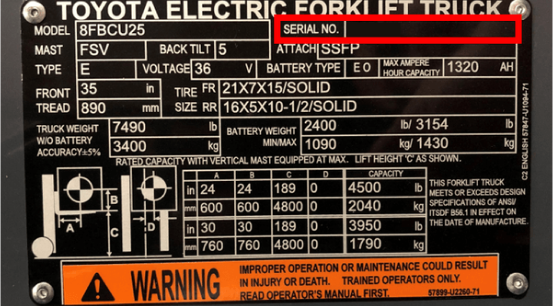
Finding the right parts for your equipment is easy when you have your model and serial number which can be found on the data plate. Luckily, a forklift data plate is installed on every truck on the market to help you understand what your forklift can do and provide vital information.
Model Number: The model number of your toyota forklift is extremely important for relaying information to your dealers about repair or technical assistance and for looking up replacements part!
Serial Number: The serial number on your lift is the most important number.The model serial number combination will allow us to provide you with the parts that will fit your particular piece of equipment.
How to Find Your Equipment Serial Number.
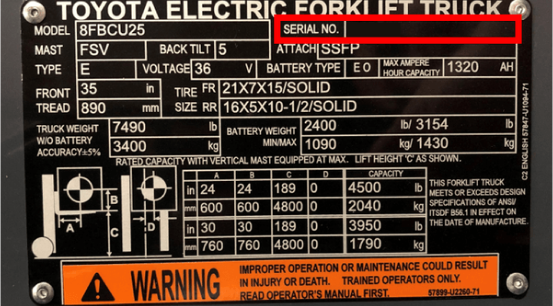
Finding the right parts for your equipment is easy when you have your model and serial number which can be found on the data plate. Luckily, a forklift data plate is installed on every truck on the market to help you understand what your forklift can do and provide vital information.
Model Number: The model number of your toyota forklift is extremely important for relaying information to your dealers about repair or technical assistance and for looking up replacements part!
Serial Number: The serial number on your lift is the most important number.The model serial number combination will allow us to provide you with the parts that will fit your particular piece of equipment.
Need some help? For further assistance or more information, contact your local Toyota Dealer.












Please click below to sign in to your MyToyota account
Don't have an account?
Leaders on Leadership: Bill Byrd

As part of a series on leadership, we asked Toyota Material Handling executives for advice for aspiring leaders.
Question and Answer with TMHNA Director of Distribution Bill Byrd
What advice would you give to a younger version of yourself just starting out in your career?
I would tell myself that you don’t have to make decisions alone. Seek out wise counsel. As you mature, you learn who to go to and for what subject, depending on the kind of counsel you’re looking for. I go to those I respect, even if I don't always agree with them, as they can help with the checks and balances
What leadership principle has shaped your success most?
Invest in people. If they are successful, I will naturally be successful.
What habits have had the greatest impact on your success?
Be slow to speak and quick to listen. Good listening is one of the most important habits a leader can develop. If you are not listening to the people around you, don’t be surprised if they no longer have anything to say. As a leader, your words can carry a lot of weight. If you speak first, you may shut down good ideas before they can become fruitful. Learn to be a good active listener. Don’t just listen to people, but hear them, especially customers.
What separates good leaders from great ones?
Cast a vision with clarity. Vision should have three things: simple, repeatable, and portable throughout the organization.
Vision and Communication: A clear, compelling vision is essential for leadership. Leaders must be able to communicate this vision effectively, ensuring that all team members understand and align with the organization's goals and objectives. A vision should be:
- Simple - easy to understand
- Portable - easy to communicate
- Repeatable - messages may get lost or distorted as they move through the organization
Lead by Example: Authentic leadership is about embodying the values and behaviors you wish to see in your team. By leading through example, leaders can inspire trust, respect, and commitment, setting a standard for others to follow.
Empathy Drives Connection: Leaders who demonstrate empathy build stronger relationships with their team members. Understanding and addressing employees' emotional and professional needs can lead to increased loyalty, motivation, and productivity.
Continuous Learning and Improvement: Great leaders are committed to personal and professional growth. They seek feedback, pursue new knowledge, and continuously refine their skills. This commitment to development not only enhances their own effectiveness but also sets a tone of continuous improvement within their organization.
What leadership mistake do you see repeated most often, and how would you prevent it?
One of the biggest mistakes leaders make is trying to make decisions on their own. Leadership is not about always getting things done right; leadership is about getting things done through other people. Assign responsibilities, not tasks. Get people’s buy-in. Getting people to accept the idea and move with it is better than coming up with the “perfect idea”.
- Q x A = E
Quality of an idea x Acceptance of an idea = Its Effectiveness
If people don’t accept an idea, it won’t be effective, no matter how perfect it is. One lesson I’ve learned from Japanese culture is the importance of nemawashi, building consensus before moving forward. You may have a great idea, but if people aren’t on board, they’ll undermine it. Consensus creates commitment.
What mindset helps leaders stay effective during uncertainty or disruption?
Adaptability is Key: Effective leaders must be adaptable, able to adjust their strategies and approaches in response to changing circumstances and diverse team dynamics. This flexibility fosters resilience and innovation within their teams.
It’s important to remember that you’re always being watched. How do you treat, how you act, how you handle stress, are you behaving in the way you are asking your people to behave? Are you showing up late, leaving early? Your people notice that. Model how you want your direct reports to act.
What is a quote on leadership that resonates with you & why?
One quote that has always stayed with me comes from the military: “Leaders always eat last. Those on the front line should always eat first.”
Another comes from General Norman Schwartzkopf, “It doesn’t take a hero to order men into battle. It takes a hero to be one of those men who go into battle.”
Ultimately, you can quote great leaders all day long, but the real question is whether you’re practicing what you preach.