









How to Find Your Equipment Model Number.
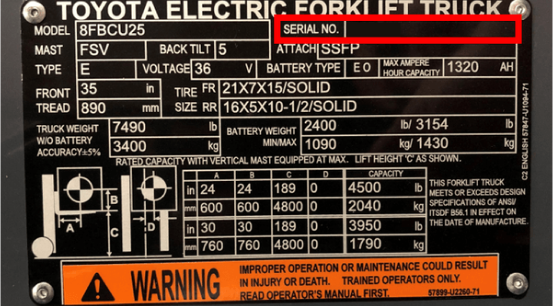
Finding the right parts for your equipment is easy when you have your model and serial number which can be found on the data plate. Luckily, a forklift data plate is installed on every truck on the market to help you understand what your forklift can do and provide vital information.
Model Number: The model number of your toyota forklift is extremely important for relaying information to your dealers about repair or technical assistance and for looking up replacements part!
Serial Number: The serial number on your lift is the most important number.The model serial number combination will allow us to provide you with the parts that will fit your particular piece of equipment.
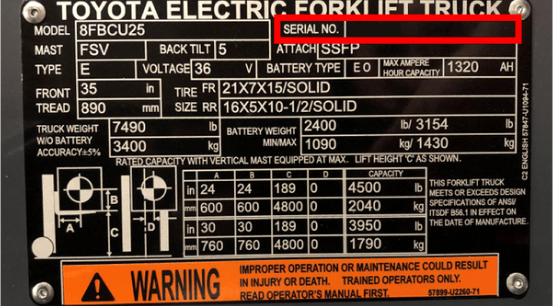
How to Find Your Equipment Serial Number.
Finding the right parts for your equipment is easy when you have your model and serial number which can be found on the data plate. Luckily, a forklift data plate is installed on every truck on the market to help you understand what your forklift can do and provide vital information.
Model Number: The model number of your toyota forklift is extremely important for relaying information to your dealers about repair or technical assistance and for looking up replacements part!
Serial Number: The serial number on your lift is the most important number.The model serial number combination will allow us to provide you with the parts that will fit your particular piece of equipment.
Need some help? For further assistance or more information, contact your local Toyota Dealer.











Please click below to sign in to your MyToyota account
Don't have an account?
Toyota Reengineers the Stand-Up Rider Forklift for Today’s Space-Constrained Distribution Centers

Warehouses and distribution centers (DCs) don’t have space to spare. Real estate costs continue to climb, aisles are narrowing, and operations are being pushed to store products higher to maximize every cubic foot. At the same time, equipment must move efficiently from trailer to dock to rack without slowing throughput.
To address these challenges, Toyota Material Handling has redesigned its Stand-Up Rider Forklift. Built for modern warehouse conditions, the updated model emphasizes performance, operator comfort, and integrated technology within tight footprints.
According to Brad Shofner, Product Planning Manager at Toyota Material Handling North America, the redesign reflects how significantly operating environments have evolved.
Key Features of the Stand-Up Rider Counterbalance Forklift
Toyota’s previous Stand-Up Rider model was on the market for approximately 15 years. During that time, warehouse environments changed considerably.
“As aisles narrow and demand increases, operators expect better ergonomics and performance than they did a decade ago,” Shofner explains.
The updated Stand-Up Rider was built to address these realities. Many operations require equipment that can move in and out of trailers and transition directly to racking without losing efficiency. While reach trucks are designed for racking, they are not built for consistent trailer work. At the same time, sit-down forklifts can be more difficult to maneuver in tighter spaces.
As facilities reduce aisle widths and increase storage density, they need equipment capable of operating in confined areas while still meeting vertical demands. The Stand-Up Rider is designed to meet those needs.
Enhancements to Support Productivity
Toyota introduced several upgrades to enhance performance and operator experience. Electric power steering is one of the most noticeable enhancements. Lift and lower speeds have also been enhanced to support productivity and increase efficiency during operation.
Travel speed remains unchanged, reflecting the reality that many facilities operate under internal limits and prioritize control over maximum speed.
The forklift also features a standard 7-inch touchscreen display, which is the largest in the stand-up counterbalance class across all OEMs.
The display provides visibility into:
- Load weight
- Mast tilt angle
- Lift height
- Diagnostics and performance data
This allows operators to access critical information more easily during operation.
Ergonomic Improvements for Operator Comfort
Operator comfort was a key focus of the redesign.
The updated Stand-Up Rider includes:
- An adjustable armrest
- An adjustable tiller
- Enhanced visibility of the tire and forks
- Repositioned components to create more usable space in the operator compartment
The comfort ride suspension remains unchanged and features a floor system that adapts to each operator’s weight to help minimize vibration and provide a smoother, more stable ride.
Forklift Telematics is Available Through MyInsights®
MyInsights®, Toyota’s telematics solution, is built into the Stand-Up Rider Counterbalance Forklift to provide real-time visibility into truck performance and usage.
With MyInsights®, managers can:
- Track operating data
- Monitor impacts
- Review maintenance needs across the fleet
Because the system connects directly to the truck, it integrates diagnostics and performance information into a single platform. This helps identify patterns that may affect uptime or operator behavior.
Configurable Packages for Operational Flexibility
Comfort Package
Performance Package
Technology Package
Integrated with Lithium-ion Battery Option
Toyota offers an optional lithium-ion battery designed specifically for the Stand-Up Rider.
Because the battery and forklift are engineered together, customers benefit from:
- Consistent performance
- Simplified service
- Unified diagnostics
This integrated approach creates a single-source solution rather than relying on third-party components.
FAQ: Stand-Up Rider Forklift
What challenges is the Toyota Stand-Up Rider designed to solve?
The Stand-Up Rider is designed for space-constrained warehouses with narrow aisles, higher storage requirements, and the need for efficient movement between trailers and racking.
How has the Stand-Up Rider been enhanced?
Key enhancements include electric power steering, enhanced lift and lower speeds, a larger touchscreen display, and redesigned ergonomics for increased operator comfort.
What information does the touchscreen display provide?
The 7-inch touchscreen display shows load weight, mast tilt angle, lift height, and diagnostic and performance data.
How does MyInsights® support operations?
MyInsights® provides real-time data on truck performance, impacts, and maintenance needs, helping managers monitor usage and identify patterns that may affect uptime.
What ergonomic features are included?
The forklift includes an adjustable armrest and tiller, enhanced visibility, additional operator space, and a suspension system that adapts to operator weight.