







How to Find Your Equipment Model Number.
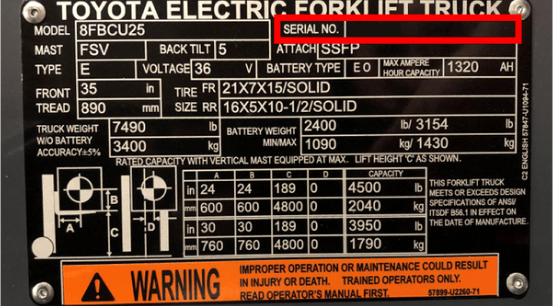
Finding the right parts for your equipment is easy when you have your model and serial number which can be found on the data plate. Luckily, a forklift data plate is installed on every truck on the market to help you understand what your forklift can do and provide vital information.
Model Number: The model number of your toyota forklift is extremely important for relaying information to your dealers about repair or technical assistance and for looking up replacements part!
Serial Number: The serial number on your lift is the most important number.The model serial number combination will allow us to provide you with the parts that will fit your particular piece of equipment.
How to Find Your Equipment Serial Number.
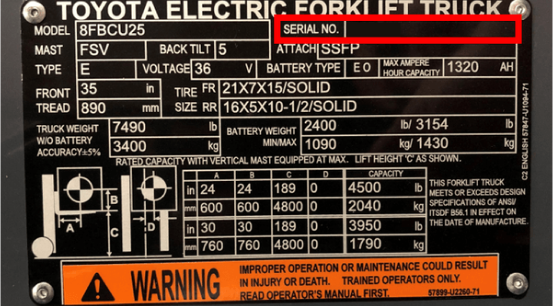
Finding the right parts for your equipment is easy when you have your model and serial number which can be found on the data plate. Luckily, a forklift data plate is installed on every truck on the market to help you understand what your forklift can do and provide vital information.
Model Number: The model number of your toyota forklift is extremely important for relaying information to your dealers about repair or technical assistance and for looking up replacements part!
Serial Number: The serial number on your lift is the most important number.The model serial number combination will allow us to provide you with the parts that will fit your particular piece of equipment.
Need some help? For further assistance or more information, contact your local Toyota Dealer.










Please click below to sign in to your MyToyota account
Don't have an account?
Forklift Parts 101: Most Common Forklift Parts and Terms

Forklift parts are the individual components that allow a forklift to lift, move, steer, and safely handle materials in warehouse and outdoor applications. Understanding common forklift parts and forklift terminology can help operators identify key equipment functions, recognize maintenance needs, and support safe, efficient operation throughout the workday.
Forklift Part Terminology
Forklift Part | Description |
Operator Compartment |
The operator compartment is the central part of the forklift. It contains the steering wheel, brake and gas pedals, mast controls, and gauges. It is also where the forklift's safety devices are located. The operator compartment can be open or enclosed.
|
Carriage |
The carriage mounts the forks to the mast and carries any attachments used for handling loads, forks, clamps, side shifters, etc.
|
Mast |
The mast is the part of the forklift that lifts and lowers the load. Different types of masts lift the load to different heights.
|
Load Backrest |
The load backrest sits between the load and the mast. It is designed to keep the load from falling toward the driver. The load rests on a flat surface, allowing for safe loading and unloading.
|
Forks |
The forks are long extensions (like arms) that are attached to the carriage. They are used to support the load from the bottom. They come in a variety of lengths and adjust from right to left on the carriage.
|
Overhead Guard |
The overhead guard is the frame around the operator compartment of the forklift. It prevents large objects from falling onto the driver. Since the overhead guard is a grate design, it does not prevent smaller objects from falling from elevated heights.
|
Tires |
The steer tires of a forklift are located in the back. They allow for maneuverability around corners and are used for moving objects while driving in reverse. The drive tires are in the front and remain in a fixed position. They do not turn on a radius as the steer wheels do.
|
Counterweight |
The counterweight is located at the back of the forklift and provides weight to counter-balance the forklift and load.
|
Power Supply |
Forklifts are available in four different power supply types: gas, diesel, propane, and electric (battery). For sit-down forklift, the battery is located under the seat, and the propane tank is located at the back of the forklift over the counterweight. Gas and diesel forklifts have a fuel tank located in the side of the frame of the operator compartment. For stand up units such as the Stand-Up Rider, the battery is located between the operator compartment and the mast.
|
Tilt Cylinder |
The amount of forward and backward tilt of the mast, forks, and carriage is controlled by the tilt cylinder.
|
Hydraulic Lift Cylinder |
The amount of vertical lift (raised or lowered) of the mast, forks, and carriage is controlled by the hydraulic lift cylinder.
|
SAS |
Toyota’s System of Active Stability™ is an industry-leading forklift technology that minimizes the likelihood of tip-over, reducing the risk for operators and those around them.
|
Keeping Your Forklift Operational
Buying a forklift is a major purchase for any organization. Planned maintenance service plans help keep your forklift working properly. Material handling specialists have rated Toyota parts the highest in terms of quality, reliability, durability, and the best value for the money since 2002.
All Toyota forklifts are manufactured with Toyota Genuine Parts and Accessories. To keep your forklift working properly, any replacement parts should also be Toyota Genuine Parts and should be purchased from an authorized Toyota dealer, or from the Toyota Forklift Shop. For information on pricing or parts, contact your authorized Toyota Dealer.
Common Questions about Forklift Parts
What are the major parts of a forklift?
The major parts of a forklift include the mast, carriage, forks, overhead guard, tires, counterweight, hydraulic lift cylinder, tilt cylinder, and power source. Each component plays an important role in lifting, transporting, and stabilizing loads during operation. Understanding how these parts work together can help operators support safe and efficient material handling.
What does a mast do on a forklift?
The mast is the vertical assembly on a forklift that raises and lowers the load. Different mast configurations allow forklifts to lift materials to various heights depending on the application. The mast works together with the hydraulic lift cylinder, carriage, and forks to support load handling and positioning.
What is the purpose of a forklift counterweight?
The counterweight is located at the rear of the forklift and helps balance the weight of the load being lifted. It prevents the forklift from tipping forward during operation and is an important part of maintaining overall equipment stability and safety. Proper load handling and understanding forklift capacity are essential for safe operation.
What does the overhead guard do on a forklift?
The overhead guard is the protective frame located above the operator compartment. It helps protect operators from falling objects and debris during material handling operations. While the overhead guard provides important protection, operators should always follow proper load handling and workplace safety procedures.
What is the System of Active Stability™ (SAS) on a forklift?
Toyota's System of Active Stability (SAS)™ is an advanced forklift system designed to improve stability, protect operators, and support productivity by detecting conditions in real time. Features such as Active Mast Control, the rear stabilizer, and speed reduction during cornering help maintain stability while improving overall efficiency. Learn more about how the system works in our blog on Toyota’s System of Active Stability™ (SAS).
How do I know when forklift parts need replacement?
Forklift parts should be inspected regularly for signs of wear, damage, or reduced performance that could impact safe operation. Components such as tires, forks, brakes, filters, and hydraulic systems may require replacement over time depending on usage and operating conditions. Routine inspections and planned maintenance can help identify issues early, reduce unexpected downtime, and keep forklifts operating efficiently. Learn more about forklift maintenance best practices in our blog on planned maintenance for forklifts.
Why should I use Toyota Genuine Parts?
Toyota Genuine Parts are designed and engineered specifically for Toyota forklifts to help support equipment performance, reliability, and durability. Using genuine replacement parts can help maintain proper fit and function while supporting long-term operational efficiency and uptime. Toyota parts are highly rated for quality, reliability, and overall value.
Learn more about replacement parts and service support through the Toyota Forklift Shop.