














How to Find Your Equipment Model Number.
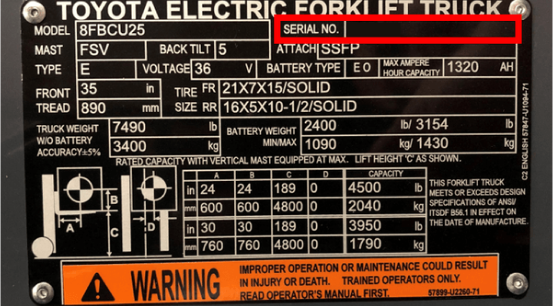
Finding the right parts for your equipment is easy when you have your model and serial number which can be found on the data plate. Luckily, a forklift data plate is installed on every truck on the market to help you understand what your forklift can do and provide vital information.
Model Number: The model number of your toyota forklift is extremely important for relaying information to your dealers about repair or technical assistance and for looking up replacements part!
Serial Number: The serial number on your lift is the most important number.The model serial number combination will allow us to provide you with the parts that will fit your particular piece of equipment.
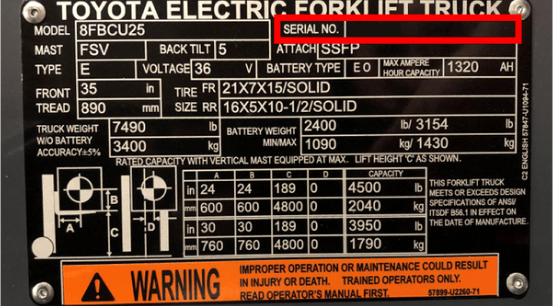
How to Find Your Equipment Serial Number.
Finding the right parts for your equipment is easy when you have your model and serial number which can be found on the data plate. Luckily, a forklift data plate is installed on every truck on the market to help you understand what your forklift can do and provide vital information.
Model Number: The model number of your toyota forklift is extremely important for relaying information to your dealers about repair or technical assistance and for looking up replacements part!
Serial Number: The serial number on your lift is the most important number.The model serial number combination will allow us to provide you with the parts that will fit your particular piece of equipment.
Need some help? For further assistance or more information, contact your local Toyota Dealer.











Please click below to sign in to your MyToyota account
Don't have an account?
Making the Switch from IC to Electric-Powered Lift Trucks

How Toyota helps logistics and warehouse managers evaluate the shift from internal combustion (IC) to electric lift trucks with an eye on total cost of ownership, performance gains, and operator security.
As electric lift truck technology continues to evolve, more logistics and warehouse operations are rethinking their reliance on internal combustion equipment. Lower lifetime maintenance costs, improved performance, and quieter operation are shifting how fleet managers evaluate equipment decisions, especially in applications that once required IC trucks.
In this Challenge Solved Q&A, Dustin Fullerton, Product Manager at Toyota Material Handling, explains the total cost of ownership’s role in IC-to-electric conversion, how the company helps its customers evaluate real-world data, and what managers should expect as they plan and execute the transition.
Common Questions When Converting From IC to Electric Forklifts
Why should companies be thinking about making the switch from IC to electric-powered lift trucks?
Total cost of ownership is a good place to start. Advances in electric lift truck technology now allow electric models to handle applications that once required internal combustion equipment, which changes the equation. Electric trucks tend to cost less to maintain over time, with more stable year-over-year maintenance expenses. IC trucks often become more expensive as they age due to wear and tear, while electric models avoid that steady cost climb. For Fleet Managers, that predictability supports long-term planning, simpler budgeting, and fewer surprises as equipment stays in service longer.
Do you find that companies understand this and how does Toyota help them evaluate their options?
Companies generally understand the concept, but they may need help visualizing it. Electric trucks may cost more upfront, but these forklifts typically deliver lower costs over the life of the equipment. This is something most people already recognize from the automotive world. The challenge is translating that idea into real numbers for a specific operation. We address this with a total cost of ownership calculator that compares IC and electric trucks side by side, or electric to electric and IC to IC. Using customer inputs like fuel versus electricity costs, operating hours, and number of shifts, Toyota Dealer can provide a year-by-year breakdown that shows how ownership and maintenance costs differ over time. This helps companies make more informed decisions.
How difficult is it for companies to transition from IC to electric forklifts?
It’s not difficult, but it can take time. The biggest adjustments are often operational and cultural. Companies move from parking IC trucks anywhere to managing charging routines, whether that’s opportunity charging during breaks or overnight charging. Those adjustments require new habits for operators and managers, especially in long-established operations. Toyota’s dealers are experienced in guiding customers through the transition.
What steps and best practices should companies follow for a successful shift?
Start with a power study. Toyota Dealers can place monitoring equipment on an existing forklift to passively collect data on work cycles without affecting performance. That data helps determine the right forklifts, batteries, chargers, and overall infrastructure for the application. From there, the path depends on the facility itself. For example, older buildings may need electrical upgrades to support an electric fleet. Our dealers and financing teams work with customers through each step to develop a practical, application-specific solution.
What key benefits can companies expect when they switch from IC to electric forklifts?
At the operator level, positive feedback usually centers around better performance and improved comfort. Electric forklifts typically feel quicker because AC drive motors respond faster than an IC engine and transmission, reducing lag and helping operators reach set speed limits more efficiently. Operators also point to lower noise levels, which can improve the overall work environment. Cost predictability is the biggest advantage at the organizational level. Electric trucks tend to deliver more consistent maintenance costs over time, making long-term budgeting easier, while IC trucks often see maintenance costs increase as they age.
They also won’t splinter as wood pallets might, and are relatively lightweight given their durability.
What else should logistics and warehouse managers know about the process and how Toyota supports them through it?
Toyota supports the transition from IC to electric at both the dealer and manufacturing levels, helping customers evaluate options, review power study data, and validate performance in real-world conditions. Many customers want to see electric trucks in action, so we offer demos that allow operators to test equipment in their own applications. They also won’t splinter like wood pallets might, and are relatively lightweight given their durability.
On the product side, we’ve expanded our electric portfolio with Integrated Electric Pneumatic Forklifts designed specifically for IC replacement in demanding outdoor applications like lumber, block, and metal handling. These trucks retain the size, capacity, and ergonomics of IC models while delivering the benefits of lithium-ion power. Finally, we’ve introduced our own LFP batteries for warehouse equipment and continue to invest in future energy solutions, including early-stage development of warehouse energy management systems. These systems help operators plan, monitor and optimize facility-wide energy use over time.